Detailed protocol to lower the barrier to entry for dissolved black carbon analysis

Various images from the detailed BPCA method protocol.

Dissolved black carbon (DBC) is the condensed aromatic portion of dissolved organic matter (DOM) that comes from wildfire, petroleum, and other thermogenic sources. The measurement of DBC allows researchers to examine the production, accumulation, and cycling of a biologically refractory (i.e. relatively inert) fraction of organic carbon in various aquatic settings. In our lab, we use the benzenepolycarboxylic acid (BPCA) method to quantify DBC along the river-to-ocean continuum, which involves the harsh oxidation of DOM extracted from water and subsequent analysis of BPCA products via high-performance liquid chromatography.

For brevity, peer-reviewed research articles and methods papers usually summarize or omit some sample preparative and analytical details. These technical omissions make it difficult for researchers who are looking to adopt or refine the BPCA method. To address this, Riley Barton led the recent publication of a step-by-step protocol and accompanying paper to lower the barrier to entry for those who want to incorporate BPCA analysis and DBC quantification into their research but do not have a high level of access to those already familiar with the method. We hope that expanding the accessibility of this method will enhance the number of DBC studies and will contribute new perspectives on DBC biogeochemistry to further the scientific understanding of this long-lived compound class in the environment.

The step-by-step protocol is freely available at protocols.io and the accompanying paper was published in the journal PLoS ONE and is entitled “Measuring dissolved black carbon in water via aqueous, inorganic, high-performance liquid chromatography of benzenepolycarboxylic acid (BPCA) molecular markers”.

Evelyn Pae wins first place at the RPI 13th Annual Undergraduate Research Symposium


Congratulations to Evelyn Pae who presented at the RPI 13th Annual Undergraduate Research Symposium last month and was awarded first place for best oral presentation in the Physical Sciences category! Her work was entitled “Effects of watershed size, hydrology, and burn extent on the composition of dissolved organic matter in fire-affected streams.”

Evelyn has spent the last year in the Wagner lab analyzing samples collected from fire-affected streams in coastal California. Before that, she published a zine entitled Molecular Tales of Marine Dissolved Organic Matter, an illustrated story that follows four molecules, who tell tales about their journey to the ocean.

We wish Evelyn the best of luck as she graduates from RPI this spring and transitions to a graduate student position at SUNY College of Environmental Science and Forestry!

Riley Barton awarded the CUAHSI Pathfinder Fellowship


Congratulations to Riley Barton who was recently awarded the CUAHSI Pathfinder Fellowship! Funds will be used to support travel to the Blue Oak Ranch Reserve (California) next winter. Barton will conduct fieldwork in headwater catchments that burned during the Santa Clara Unit Lightning Complex fires and interface with our collaborators at University of California, Santa Cruz.

The Pathfinder Fellowship program provides travel funds to graduate students in hydrology and related sciences to make an extended trip to enhance their research by adding a field site to conduct comparative research, collaborating with a research group, or working with researchers on adding an interdisciplinary dimension to a project.

Sasha Wagner named ASLO Fellow


The Association for the Sciences of Limnology and Oceanography (ASLO) recently named Sasha Wagner a 2021 Fellow. The ASLO Fellows program was initiated in 2015 to honor individuals who have given tirelessly of their time and talents to support ASLO's mission to advance the sciences of limnology and oceanography. As a named ASLO Fellow, Wagner is recognized for her exceptional contributions to the benefit of the society and its publications, meetings, and other activities.

Photochemistry as a driver of dissolved organic matter composition in glacial runoff

Mendenhall Glacier in Alaska. Photo by A. Stubbins.

The dissolved organic matter (DOM) in glacial runoff is relatively old and mostly made up of aliphatic molecules (i.e. molecules are built mainly from carbon chains rather than aromatic rings). However, the observed composition of DOM in glacial runoff is the opposite of what we would expect to observe based upon known sources of glacial DOM. We assume glacial DOM is primarily derived from organic matter in soils or deposited aerosols, like soot or other combustion products. When mixed with water, soils and aerosols release DOM that is compositionally dissimilar from DOM in glacial runoff … why is this?

In a recent study, led by Amy Holt (Florida State University) and co-authored by Sasha Wagner and others, determined that photodegradation of DOM in glacial environments may explain the difference in composition between glacial DOM sources (soils and aerosols) and DOM in glacial outflows. The researchers conducted a series of experiments, where soils and aerosols were leached in water, then exposed to sunlight in a solar simulator for several weeks. Ultrahigh resolution mass spectrometry was used to evaluate how the molecular “fingerprint” of glacial DOM sources changed during the photodegradation experiment. After extensive photo bleaching, the composition of DOM samples converged, becoming more similar to the molecular composition of DOM in glacial runoff. Taken together, the study findings suggest that photochemical degradation of aged, aromatic DOM sources could explain the observed composition of DOM in glacial outflows. This work is entitled “Assessing the role of photochemistry in driving the composition of dissolved organic matter in glacier runoff” and was published in the Journal of Geophysical Research: Biogeosciences.

Probing the source and Structure of petroleum asphaltenes

Typical images of liquid petroleum (left) and the glassy asphaltene fraction (center). Asphaltene molecules have a condensed aromatic core (right).

Petroleum is a fossil fuel and is also made up of thousands, if not millions, of different organic molecules. Some of these molecules have a condensed aromatic core structure (like a honeycomb) and are referred to as “asphaltenes” - As the name implies, these molecules are also present in road asphalt! Relative asphaltene content largely controls the viscosity and other physicochemical properties of crude oil, so we set out to gain a better understanding of this sticky petroleum component.

A new paper, led by Alex Goranov, describes how molecular markers and isotopic analysis can be used to interrogate the condensed aromatic structure and source of asphaltenes present in crude oil. The paper is entitled “Characterization of asphaltenes and petroleum using benzenepolycarboxylic acids (BPCAs) and compound-specific stable carbon isotopes” and was published in the journal Energy and Fuels as part of the 2021 Pioneers in Energy Research: Alan Marshall special issue. These investigations may also help us track organic matter inputs from oil seeps or other petrogenic carbon sources in the natural environment.

Molecular Tales of Marine Dissolved Organic Matter

The following excerpts are taken from the article “Exploring science visually“ that was originally written by Evelyn Pae and published in the RPI Every Day Matters blog on 13 October 2021.

“To study chemistry is to study the art of sequential storytelling. Each step in a chemical reaction is a new progression of events: the loss of an electron, the formation of a bond, and the introduction of a catalyst. The same actors — carbon, hydrogen, oxygen, and nitrogen — dance through scene after wondrous scene, re-enacting classic sequences in labs across the nation and in innumerable natural environments.

Look deeply into an organic chemistry reaction mechanism diagram and you can see that it is like a step-by-step cartoon — a highly precise, scientific cartoon and a visualization in symbols of the elusive processes that cannot be perceived with the naked eye. It was a fascination with this type of scientific imagery that inspired me to create Molecular Tales of Marine Dissolved Organic Matter with Rensselaer Polytechnic Institute Professor Sasha Wagner, who is supervising my undergraduate research in dissolved organic matter biogeochemistry this semester. Molecular Tales, a product of chemistry nerdery and quarantine boredom, is an illustrated booklet that follows the story of four different organic molecules, each with its own provenance and character, through their respective journeys to the sea.”

“Science communication is a field that I believe will only become more relevant in the future. It doesn’t always have to be big and flashy. Like our zine, it could be a slim booklet that fits into a pocket, refusing to take itself too seriously. Or, like dissolved organic carbon itself, it could be there in the background of your daily life: always present, critical and fundamental, yet often unnoticed until you learn a new way of looking at it. I hope Molecular Tales offers readers a new — and fun — way of looking at the world we live in.”

The zine is freely available and can be viewed as an e-booklet or downloaded as a PDF file.

TRacking molecules from an underground oil spill near Bemidji, Minnesota

Site of 1979 oil spill near Bemidji, Minnesota - Groundwater wells are seen sticking up from the ground.

Site of 1979 oil spill near Bemidji, Minnesota - Groundwater wells are seen sticking up from the ground.

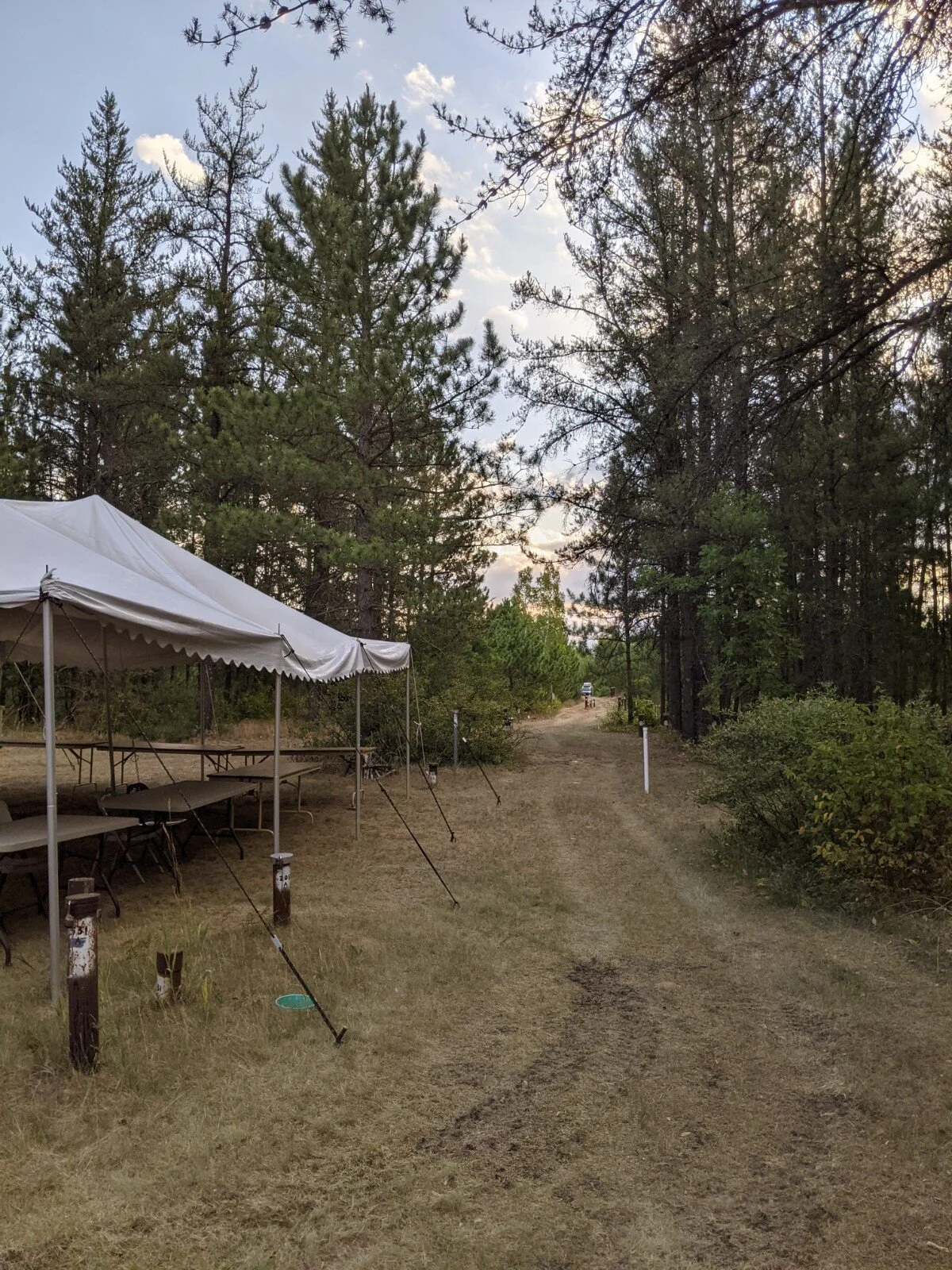
Sasha Wagner received funding to investigate and track bio-refractory (i.e. resistant to microbial degradation) petroleum products in a shallow aquifer near Bemidji, Minnesota at the site of a 1979 oil spill. After clean-up efforts, ~400,000 liters of oil remains beneath the ground near the water table. The remaining oil continues to be a source of contaminants to the aquifer and has been monitored as part of the USGS National Crude Oil Spill Fate and Natural Attenuation Research Site for the last 30 years. In August, Sasha collected groundwater samples as part of the 2021 field campaign at the site. Ongoing research, led by PhD student Alex Collins, seeks to use stable carbon isotopes to track oil-derived compounds along the subterranean oil plume and to characterize natural (background) and oil-derived dissolved organic matter in groundwater.

Top row

  1. View towards unnamed lake from site tent

  2. Water quality assessment at well

  3. Samples collected for carbon analyses (note orange-colored iron precipitation)

  4. View of oil pipeline corridor

Bottom row

  1. Filtration and sample collection

  2. Working at the field station

  3. Remaining oil can be seen in the soil core

  4. Sample extraction in the hotel room

Investigating whether wildfire ash has an effect on dissolved black carbon in coastal waters

View of the Thomas Fire smoke plume from the International Space Station. Photo by NASA.

View of the Thomas Fire smoke plume from the International Space Station. Photo by NASA.

Charcoal and soot are formed during wildfire and when these fire-derived products interact with water, some of it dissolves and enters aquatic systems. The soluble component of charcoal and soot is termed “dissolved black carbon”. The main goal of a study, recently published by Sasha Wagner and colleagues, was to investigate whether the deposition of ash from the Thomas Fire (California, USA) had a measurable effect on dissolved black carbon in coastal surface waters. Beneath the smoke plume, dissolved black carbon concentrations were higher than other areas sampled. They also found that when Thomas Fire ash was mixed with seawater, it leached a substantial amount of dissolved black carbon. The release of dissolved black carbon from ash was further enhanced when the experiment was carried out under natural sunlight. Using carbon isotopes, they tried to estimate inputs of dissolved black carbon from ash to Santa Barbara Channel surface waters during the Thomas Fire. However, ash dissolved black carbon contributions were too small for them to effectively track inputs using carbon isotopes. Given the unpredictable nature of wildfires, they are logistically challenging to study in real time. This work provides a first step toward understanding atmospheric inputs of dissolved black carbon to coastal ecosystems impacted directly by wildfire. This work is entitled “Investigating atmospheric inputs of dissolved black carbon to the Santa Barbara Channel during the Thomas Fire (California, USA)” and was published in the Journal of Geophysical Research: Biogeosciences.

Questions remain about the biolability of dissolved black carbon

The heating and partial combustion of organic matter produces a diverse suite of organic compounds that range from sugar-like molecules to graphite. Charcoal formed at high temperatures, here termed “black carbon”, tends to be less biolabile (i.e. less degradable by microbes) than charcoal formed at low temperatures. Consider how you make and enjoy a piece of toast: Lightly singed bread is quite tasty (or “biolabile”), whereas bread burnt to a crisp is bitter and unpalatable. When charred material interacts with water, some of it dissolves and is carried away by rivers to the ocean. Therefore, understanding the relative biolability (or “tastiness”) of dissolved black carbon is important for understanding whether or not it is degraded in rivers before entering ocean waters.

A gradient of toast.

A gradient of toast.

Isolating and tracking different molecular components of charcoal and black carbon in the environment is very challenging from an analytical perspective - Different methods measure different fractions of charcoal along the “combustion continuum”. Therefore, charcoal and black carbon are operationally defined by the method used to quantify and characterize it. Questions still remain about exactly how, or to what degree, the analytical windows of these methods overlap … if they overlap at all.

Sasha Wagner and colleagues recently published a Matters Arising in Nature Communications entitled “Questions remain about the biolability of dissolved black carbon along the combustion continuum” that dives into discussion about the comparison of black carbon analytical windows, biolabile charcoal fractions, and the terminology used to describe this important yet enigmatic compound class.